The Act of Interpretation
- Fall 2009 - Prof. Steve
Evans
Reading
Syllabus • Subject to change; check back frequently. Current week here.
week 1 - what is representation?
1 Sept | Introduction to course. Norton: Introduction (1-8).
Log | Introducing the course and ourselves. The place of 271 among the "core requirements" for the English Major. Comparing notes about 170 and 222. First definitions of "semiotics" and "hermeneutics." In-class writing assignment and sampling of responses. "The act of interpretation is like...." Some scenes of misinterpretation in everyday life. On judging a book by its cover: the many ways the Norton anthology says "I'm just boring." The textual waterfall. Preview of reading for Thursday: Gorgias's defense of the apparently indefensible Helen, Socrates's exchange with the rhapsode, Ion.
3 Sept | Norton: Gorgias (29-33, on-line); Plato, "Ion" (35-48; on-line). Proust, Swann's Way (3-9).
I. In-class writing: "scenes of reading." Circulation of "Leda and the Swan" by W.B. Yeats, for further discussion on Tuesday, September 8.
II. Quick check-in on course materials, including this website, the "log" feature to the syllabus, the FC folder, and the John Hopkins Guide to Literary Theory & Criticism. A syllabus organized around questions: to begin with, "what is representation" (mimesis).
III. Review of concepts from Tuesday: semiotics, hermeneutics. The value of etymological evidence. The fact of language precedes us as individual speakers. No scientific consensus yet on "invention" of language. The role of hermeneutics in the rediscovery of texts from antiquity (more on this in week six).
IV. The hermeneutic circle. From part to whole, and back again. Also: from manifest to latent (Freudian terminology), present to absent. The role of "foreknowledge" in our encounter with texts. The part-whole dynamic "scales" nicely (rather as fractals do): the whole of Proust's Remembrance of Things Past, the whole of Proust's writings, the whole of literature in French, the whole of the French language, etc.
V. Some initial observations on the experience of reading (or rereading) Swann's Way. We bring expectations and assumptions (foreknowledge) to the textual encounter: what to do when a text defies those? Aside on Proust's compositional practices. (Another image.)
V-bis. Representation and Repetition: the comforts and pleasures of returning to a particular text. The example of films we rewatch a ridiculous number of times. E.g., Sound of Music, Big Lebowski, Howl's Moving Castle. Representation supplies structure that reality lacks; insulates from exposure to risk and change.
VI. The rigors of reading "in the brick." Why, given all we observed about it on Tuesday, might this anthology take the form it does? "To weed out the rabble"? To equip those who master it with specialized knowledge? Theory as a foreign language. Primary acquisition of lexicon and grammar between 2-5 years old; second big push in college. Deciding what to look up, what to let slide.
VII. Gorgias's "Encomium of Helen." The best argument is the one that wins—independent of its validity in terms of truth-content or moral rightness. Gorgias's two objectives: to convince the reader of Helen's blamelessness, and to demonstrate the superiority of his rhetorical skills. Sophists as "school of thought" (Steve) and as "members of a profession" (Norton): no shared doctrinal content, rather a shared interest in effective rhetorical techniques; later treated as a "school" by those who opposed their perceived indifference to "truth." The status of the better argument in intellectual life, where recourse to physical force (decisive in most other spheres of life) is prohibited.
VIII. When you've read this log entry, drop Steve an e-mail saying so. If you think of something we covered in class, but is omitted here, send it along.
week 2 - what is representation?
8 Sept | Norton: Plato, "Republic" (49-80), "Phaedrus" (81-85). Proust 8-48. Recommended: Johns Hopkins Guide to Literary Theory & Criticism (henceforth GLTC) entry on Plato.
I. Reading check: Contrast the style and method of argumentation employed by Gorgias in his "Encomium" and Socrates in the dialogues assigned for today.
II. Interpreting "Leda and the Swan" by W.B. Yeats. The hermeneutic circle. Recognizing codes, activating frames, asking questions. Preview of Aristotelian terminology: lexis (language, diction), dianoia (thinking-through). Power and knowledge.
III. Socrates as agent of cultural revolution. His assault on the meaning-making myths of his society. Breaking up with poetry.
IV. Mimesis, representation: would you hit the "off" switch, if you could?
10 Sept | Norton: Aristotle, "Poetics" and "Rhetoric" (86-121). Proust 48-100. Recommended: GLTC entry on Aristotle.
I. No reading check!
II. A semiotic formula of sorts: W (sender) says let X (sign) stand for Y (thing signified) to Z (receiver) in situation A. Related lesson in C.S. Peirce's primary typology of signs: when sign resembles thing signified (icon; e.g. portraiture); when sign is related to thing signified by arbitrary convention (symbol; all linguistic signs belong to this category); when sign is caused by or existentially related to thing signified (index; e.g. the bullet hole, smoldering cigarette, lipstick on collar).
III. Plato. Review of the arguments and analogies employed in the "Ion" dialog. The magnetic field: god, muse(s), poet, rhapsode, spectator. What does poetry know? Is its mode of knowing valid? Not on rational grounds. The charisma of irrationality. The Republic, a reflection on the question: what would a good community look like? Must we lie to children? The Socratic-Platonic breakthrough (foreshadowed by Parmenides): God is one, god is good. Conceptual groundwork for monotheism. Answering the question "would you turn mimesis off if you could?" Mimesis in the sense of "monkey see, monkey do" (pace Aristotle).
IV. Proust. The "apprenticeship" to sign systems, of various orders and complexity. A three thousand page utterance of a single "I": epic subjectivity. But who is narrating? And when is he narrating? Little Marcel. "For a long time" (frequentative) vs. "one day" (singulative).
Swann's way: his manner(isms), his existential path. "The Way by Swann's" rejected as title for American edition of Lydia Davis's translation. Steve's first encounter with Proust, via this page by Roland Barthes (cf. week ten).
V. Assignment: Identify three scenes of message exchange in the "Combray" sections (I and II) of Proust's Swann's Way. Identify the constituent elements of the exchange using the formula "W says let X stand for Y to Z in situation A" and describe the message's fate (interpreted as intended, interpreted in a manner other than intended, misinterpreted, unheeded, etc.). A few sentences for each scene should do. Submit your assignment as a First Class e-mail to Steve no later than noon on Tuesday, September 15.
week 3 - what is representation?
15 Sept | Norton: Aristotle, "Poetics" and "Rhetoric" (86-121). Proust 100-150.
I. In-class writing: Report on Proust progress, challenges and pleasures.
II. Message exchange in "Combray" section of Swann's Way. Various episodes drawn from assignment due earlier in the day. Further framing remarks about Proust and his project.
III. Aristotle's six structural features: muthos (plot), ethos (character), dianoia (reasoning, thinking-through), opsis (spectacle), melopoeia (song), lexis (diction, often left untranslated). Also, reversal (peripeteia) and recognition (anagnorisis).
17 Sept | Norton: Horace, "Ars Poetica" (121-135). Proust 150-200. Recommended: GLTC entry on Horace.
I. Reading check: Advice from Horace on the craft of writing.
II. The "canonical narrative tempos": ellipsis, summary, scene, stretch, and pause. Life > mimesis (at least until recently). The necessity of editing, leaving out. Hitchcock: "Drama is life with the dull parts left out." Plot~story distinction, discours~récit (in French tradition), syuzhet~fabula (in Russian tradition); manifest~latent (in Freud).
III. In which I made the case that Proust's Remembrance of Things Past is actually quite short. Reasoning thus: Having lived 51 years, or roughly 18615 days, and being easily capable of producing a page for each day, Proust nevertheless kept himself to just 3200 pages, only 17% of what he might have presented (that's 83% edited out).
IV. Aristotle review. The six features common to all tragedies: plot, character, reasoning, spectacle, song, and language. Reversal and recognition. Catharsis.
V. Assignment: Based on your reading and annotating in the first three weeks of class, prepare one sheet of notes each for Plato, Aristotle, and Horace. Due in hardcopy in class on Tuesday, September 22.
week 4 - what is language?
22 Sept | Norton: Saussure (956-977). Proust 200-250. Recommended: GLTC entry on Saussure.
I. In-class writing: Assessing your note-taking strategies in wake of assignment due today. What's working? What needs improvement?
II. A provisional farewell to antiquity: Gorgias, Plato (and Socrates), Aristotle, and Horace. Hello, modernity: Saussure (Swiss), Jakobson (Russian), Levi-Strauss (French), Austin (English), and Heidegger (German). Pronunciation lesson.
III. Our new chapter, and next question: "what is language?" Saussure's role in shifting from an emphasis on historical reconstruction of "natural" languages (philology) toward systematic inquiry into the structural principles governing any and all possible languages. His distinction between langage (actual, natural languages), langue (system of differences), and parole (speech act or event).
IV. The principle of arbitrariness. Review of Peirce's typology of signs: icon (sign resembles thing signified), index (sign points to—or was caused by—thing signified), and symbol (sign linked to thing signified by arbitrary convention). Semiotics (or, as Saussure called it, semiology) as the study of all sign systems; linguistics as the study of verbal sign systems governed by "arbitrariness" principle. Motivated signs (icons, indices) vs. arbitrary signs (all linguistic ones, including onomatopoiea, according to Saussure).
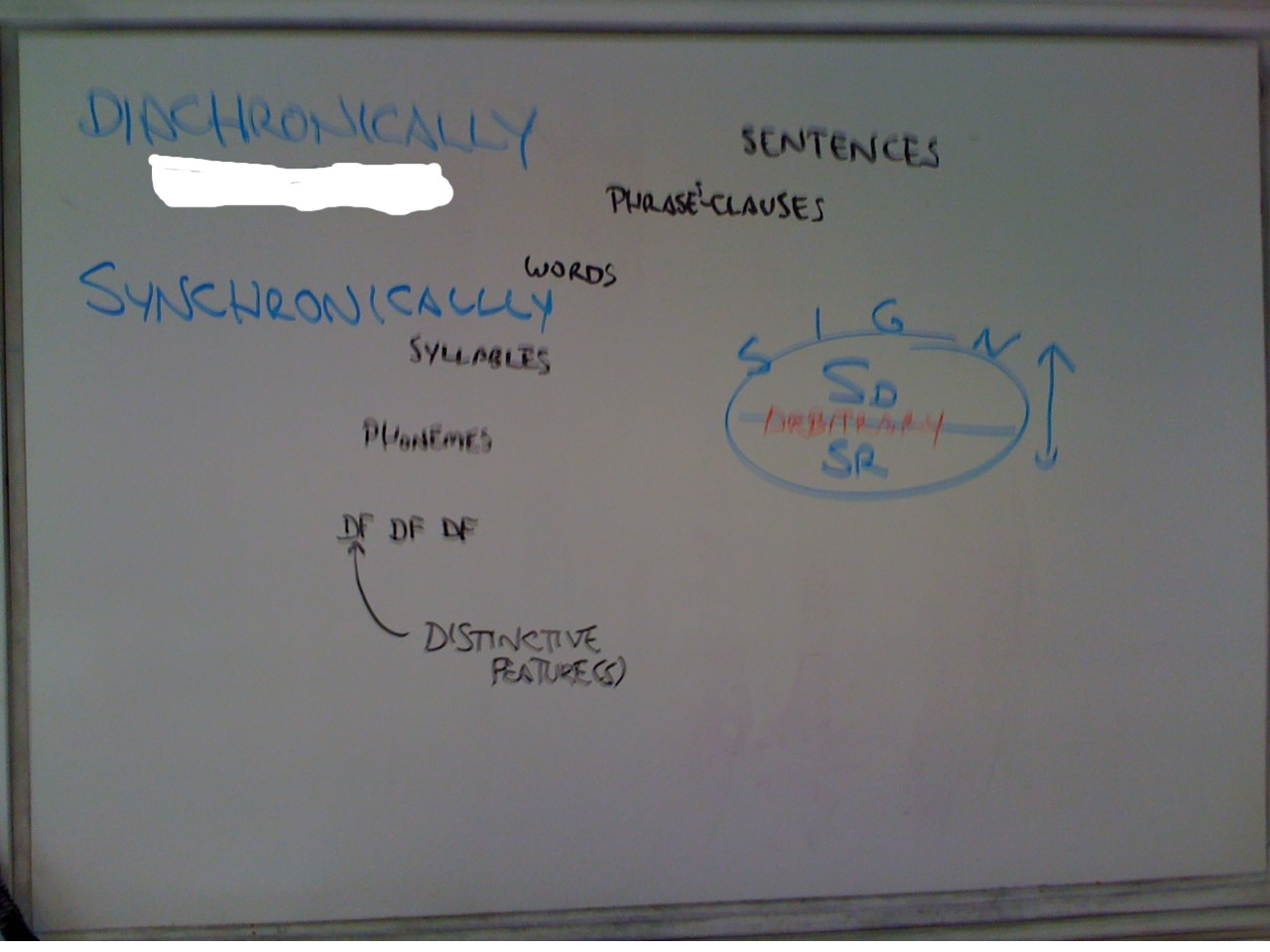
V. Definition of the SIGN as the union of a SIGNIFIER (acoustic-image) and SIGNIFIED (concept). Link between signifier and signified is arbitrary, as is the link between sign and referent. Little lesson on phonemes (smallest unit of meaningful sound). The forty or so phonemes of American English. The importance of pauses (in speech, which permit one sound wave to decay, making room for a next) and white space (upon which written letters can "stand out" and remain distinct from one another). Anecdote of the three-and-a-half year old who, though not yet able to spell words, can tell when phonemes are wrongly combined. My cat Circe's distaste for "sound poetry."
VI. Paradigm and syntagm. The axis of selection (paradigmatic; the y or vertical axis) and the axis of combination (syntagmatic; the x or horizontal axis). In the fashion system, your closet is the paradigm, the outfit you're wearing the syntagm. Selecting between like items. In langugae, the sentence as syntagm. E.g. "I never said I loved you." See Daniel Sandler's helpful overview here.
VII. Signification, value (a too rapid introduction). Consider all the words by which we might designate a "state of less than perfect sobriety." They all have roughly the same "signification," but the choice of a particular word, from the field of related words—e.g. fractured, wasted, crunk—gives it a different "value."
Coda. You can read more about Saussurean linguistics in the GLTC entry on Language and Linguistics. And you can order your T-shirt here.
24 Sept | Norton: Jakobson (1254-1269). Proust 250-300. Recommended: GLTC entries on Saussure and Jakobson.
I. In-class writing: How did you get to, and what did you take from, the GLTC entry on Saussure I asked you to look at for today?
II. Continuing our conversation about "crunk," from Tuesday. According to two authorities: Urban Dictionary & Busta Rhymes (both sources involve graphic language). KR + UNK. CRazy drUNK. CHRonic (-ally high) + drUNK. (On) CRack + drUNK.
III. Bundling (cf. ¶12 of Saussure entry on GLTC). Distinctive features < phonemes < syllables < words < phrases & clauses < sentences. Emergent properties at each level. About the International Phonetic Alphabet (click to enlarge chart). Aside on "non-pulmonic consonsants."
IV. Saussure's distinction between diachronic (across time) and synchronic (at one time; freeze frame) analysis of language. The analogy to a chess game: the board at this moment, the "moves" that lead to this moment. Also: the game defines the pieces—e.g. nothing intrinsic to a piece of wood shaped like a horse head dictates that it can move up two spaces and over one. Similarly, nothing intrinsic to the grapheme "i" dictates that it be pronounced one way in "paradigm" (long i) and paradigmatic (short i). Function is distributed relationally. (Hence, a system consisting only of differences.)
V. Paradigm and syntagm. The axis of selection and the axis of combination. Also, the axis of metaphor (substitution of like for like) and the axis of metonymy (substitution of a thing for what it's next to or near to). Aside on the role of metonymy in advertising: the miraculous migration of Johnny Depp-itude into the advertised watch (or the Mont Blanc pen).
VI. The linear nature of the sign: The outfit (syntagm) you select from the closet (paradigm) in order to arrive at class today clothed. The phrase: "I never said I loved you," which generates different messages depending upon where one places the stress. Analogy to Russian actor pronouncing "this evening" in anecdote from Jakobson. The undecidability of homophones: e.g., from The Smith's song "How Soon is Now": "I am the son/sun and heir/air." Finally, "I am soooooo X" (where X=state of less than perfect sobriety) stated at a party at 2am, and the statement "I was soooo X" stated the next day at 2pm. The "fuzzy set" of related items that constitute the paradigm: drunk. Aside on the drunkenness of both Noah and Lot.
VII. Six functions of message exchange as defined by Jakobson (handout): emotive (focus on addressee), conative (focus on addresser), referential (focus on context), phatic (focus on channel), metalingual (focus on code), and poetic (focus on signifying material). Examples of each.
Bonus. "Are You F*cking Kidding me? (Facebook Song)" by Kate Miller-Heidke.
week 5 - what is language?
29 Sept | Norton: Levi-Strauss (1415-1427); Austin (1427-1442). Proust 300-350.
I. In-class writing: (a) What does the phrase "arrange the cattleyas" mean in the context of Proust's Swann in Love? (b) Who, in the reading for today, made the claim that writing was invented in order "to facilitate slavery," and what did he mean by it?
II. Preliminary discussion of Swann and Odette's relationship. Desire crystallizes at moment Odette is "lost" to Swann. An "x-ray" of a love affair, an hermeneutics of its "codes." The passage from indifference ("not my type") to indifference, by way of many intermediary steps, including desire "propped up" by association with aesthetic objects (the little phrase, a certain painting), jealous rivalry, and so on. The "intermittencies of the heart." • Bonus: Jeremy Irons reads Proust before an arrangment of two-dozen cattleyas, in advance of the release of Volker Schlöndorff's film adapation of Swann in Love. More about the orchid in question.
III. What Levi-Strauss meant by the claim that writing "facilitates slavery." Background on Levi-Strauss and "structural anthopology." His landmark analysis on Baudelaire's "Les Chats," coauthored with Jakobson (1962). The slavery thesis: a bold argument, extrapolated from an anecdote in his field work. Class discussion, for and against the thesis. The counterargument we can associate (as Barbara Johnson, drawing on Henry Louis Gates, has done in her essay on "Writing" in Critical Terms for Literary Study) with Frederick Douglass, an American born into slavery who found literacy to be an instument of liberation.
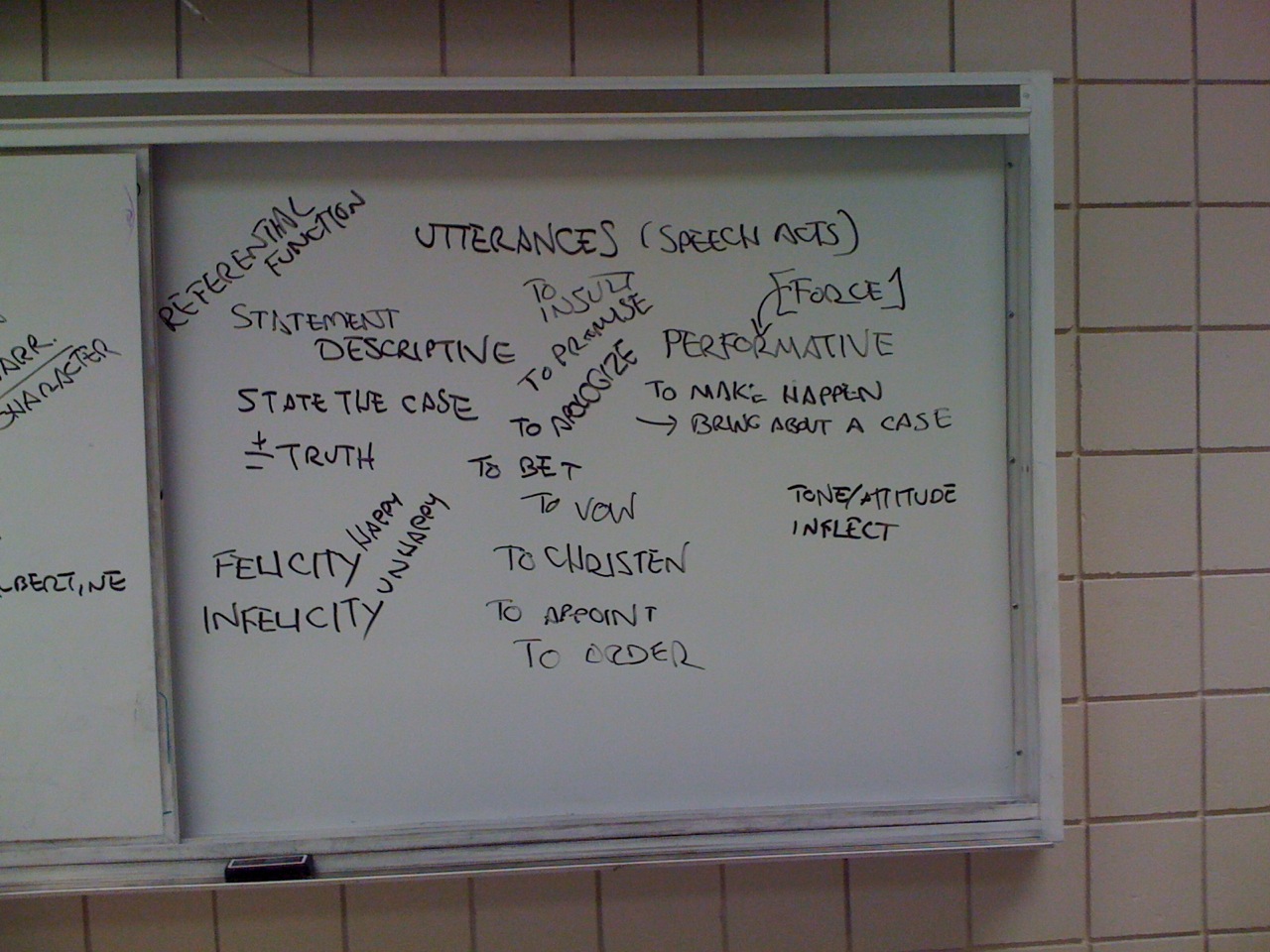
IV. Austin on "performative utterances." Whiteboard. Many points of connection to Jakobson's "six functions" (cf. handout from Sept. 24 and here). Distinction between descriptive statements of "what is the case" (constatives; foregrounding Jakobson's referential function) and performative utterances that bring about a new case. Statements are true or false (validity conditions); performative utterances are "happy or unhappy" (felicity conditions). Tone and inflection (e.g. in the phrase "I never said I loved you"). Among the many examples of performatives: to vow (e.g. marriage & divorce); to christen (a ship, a child; aside on liking one's own name—or not); to appoint (example not reproducible on the Internet); to order (someone to do something, foregrounding Jakobson's conative function); to bet (with asides on bookies in southern New Jersey and Providence); to apologize (one of the most complicated performatives, foregrounding Jakobson's emotive function and questions of "sincerity"; "I apologize but I'm not sorry"; an apology doesn't "come off" until it is accepted); to promise; and to insult (the difference between giving offense, and taking it).
V. Here is where the carefully prepared questions were to have been asked.
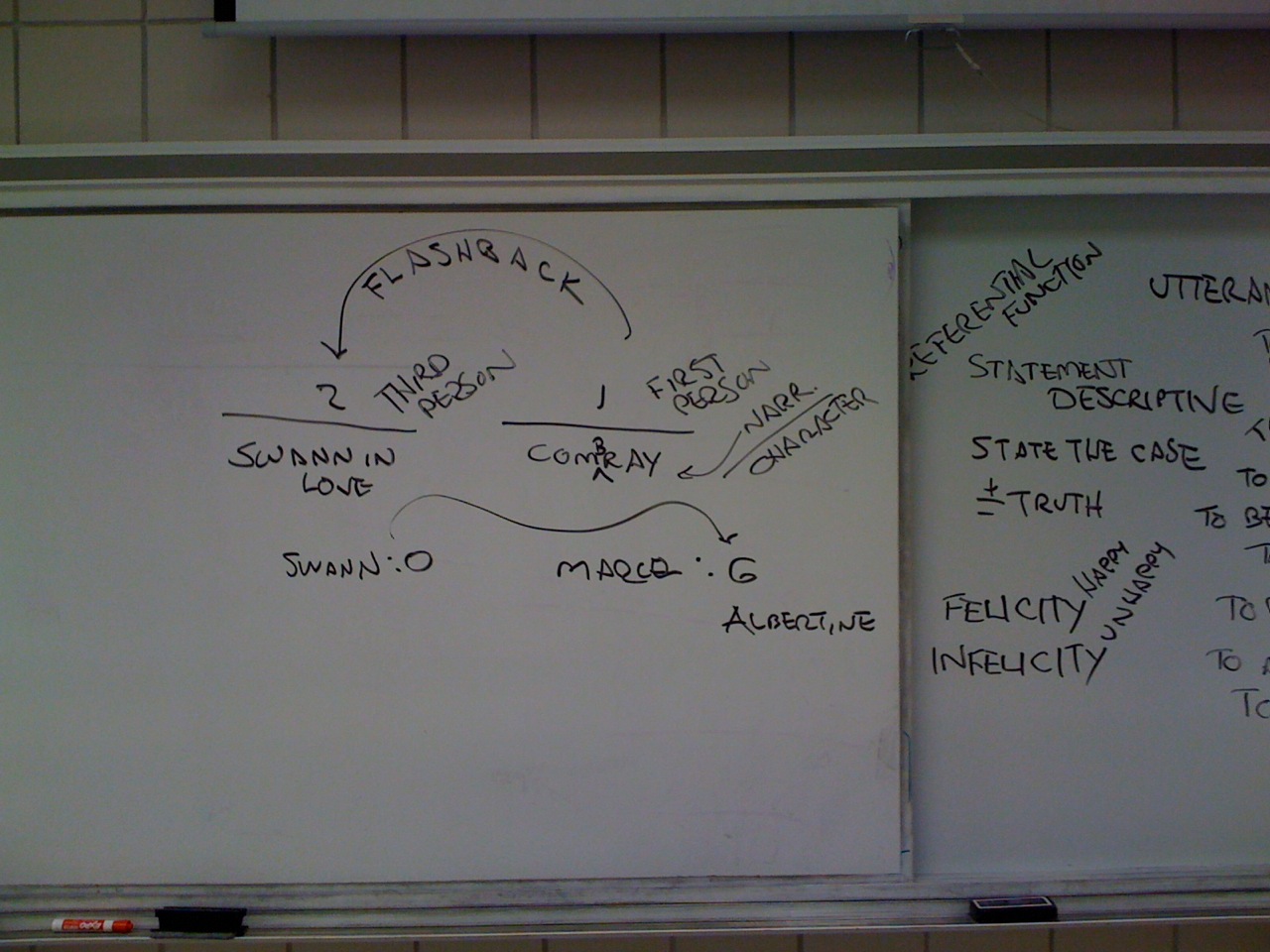
VI. Question about the structural relation between "Combray" and "Swann in Love" components of Swann's Way ("plot" order 1-2, "story" order 2-1; cf. Sept 17, item II). Whiteboard. Parallels between petit Marcel and Swann. Origins & consequences. Narrative audacity—detailed and sustained flashback to a moment before the narrator was himself conscious. • Vegetative metaphors and sexuality: not just Odette's orchids, or Gilberte in the hawthornes, but—in the second volume of The Search—a "budding grove" from which Marcel selects one flower, Albertine. Not restricted to heterosexuality—as later scenes with Baron de Charlus (played here by Alain Delon) will show.
1 Oct | Norton: Heidegger (1118-1135). Proust 350-400.
I. In-class writing (open book): Distinguish Heidegger's approach to the question "what is language" from the other writers we've read in this "chapter" of our syllabus. Select out a few specific phrases or sentences that troubled you while doing the reading for class discussion.
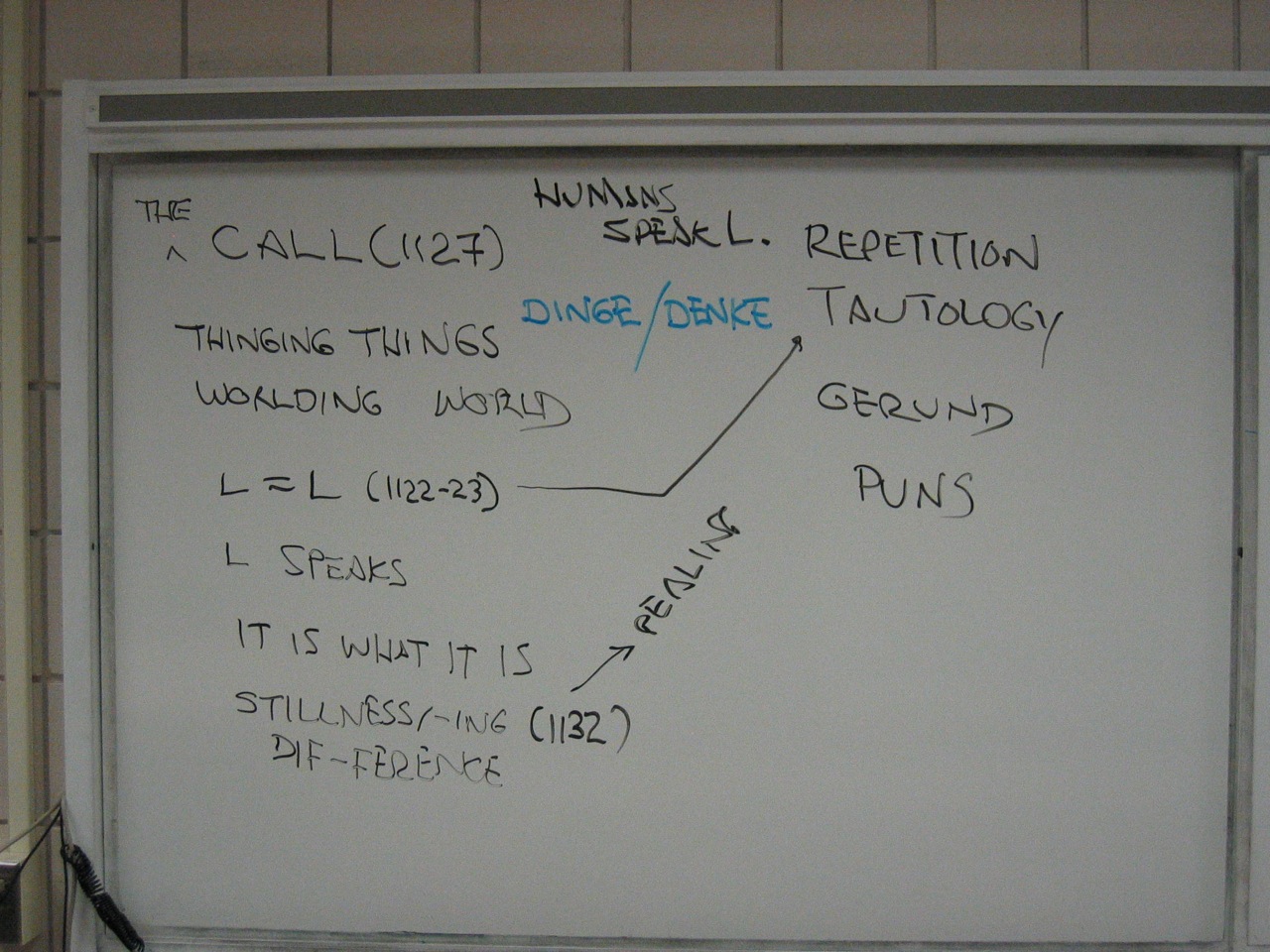
II. Heidegger's style of thinking. Some observations in the guise of complaints. Whiteboard. Repetition and tautology. When subject and predicate are identical. The "It is what it is" of resignation; the reverent form: [Proper name] is [Proper name], e.g. Mary is Mary, or John is John. Or God is God. Not wishing to reduce by characterizing. Aside on negative theology. And Heidegger's attraction, despite his own secularism, to some modern theologians. "Only a God can save us." Verbing nouns (thinging things, worlding worlds). The gerund of ongoing action. The project of occidental reason boiled down to a pun: to think things (only difference, a velar plosive ±voice). Works in German, too: dinge, denken. What dif-ference would it make if things didn't have us to think them? Aside on "anthropocentrism" (thanks Gail!), looking ahead to the first paragraph in the Nietzsche we'll read next week. Taking a "calculated" risk of igniting the atmosphere. Heidegger to the linguists: what you know is correct, but trivial.
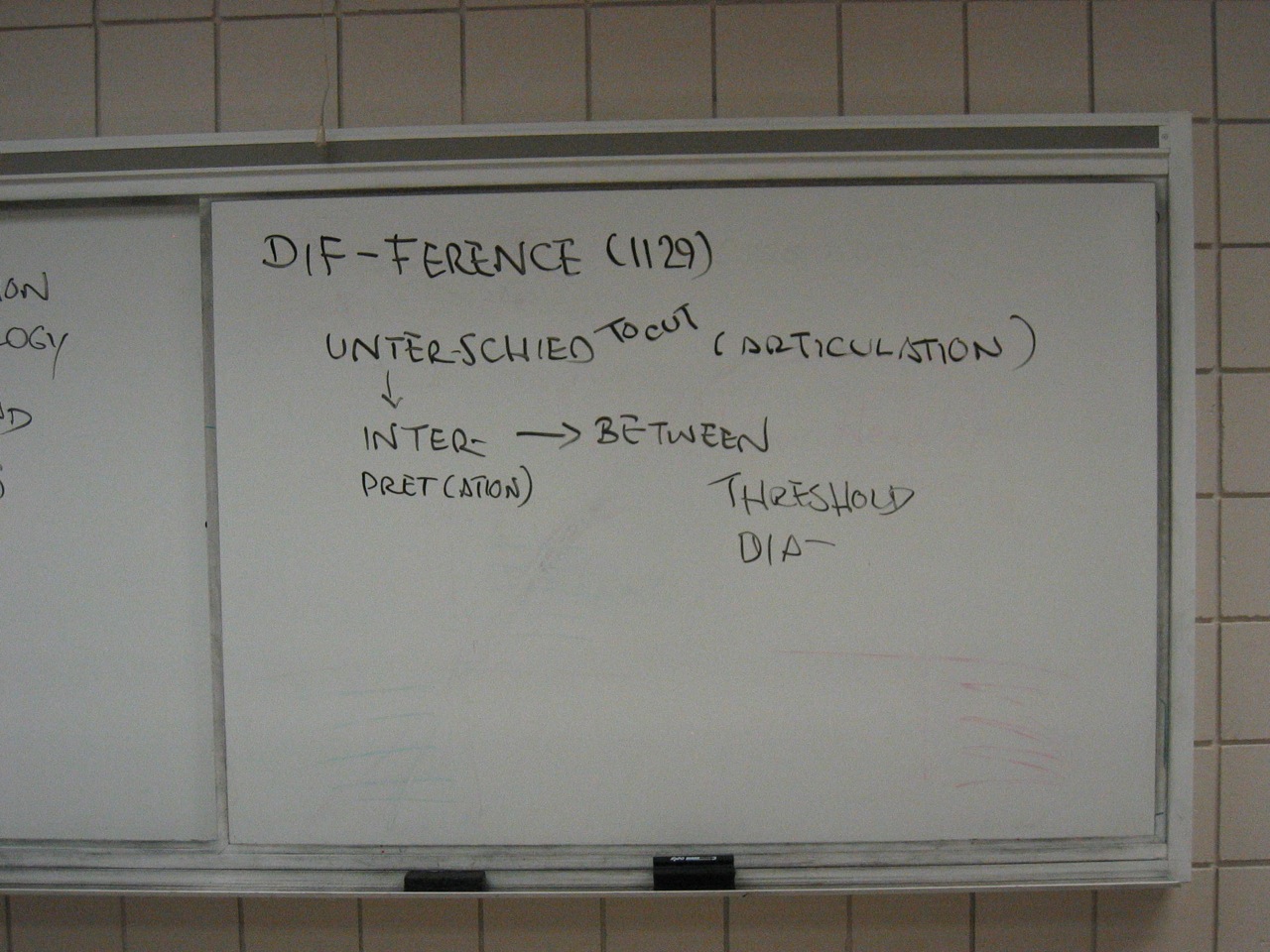
III. Dif-ference. Whiteboard. Unter-schied (German), inter- (Lat.), dia- (Grk.). Inter-pret(ation). Articulation qua the cut that connects. As in Saussure. The between. Threshold separating our classroom from, while connecting it to, the building as a whole.
IV. Heidegger as reader of poetry. Hearing the German (thanks Nick!). Thinking with the terms provided by the poem. Indifferent to authorship (cf. "The Death of the Author" we'll be discussing on November 5). The "peal" of vesper bells—contrasted to the dubious tunes electronically emitted from our campus belltower morning and night (no offence to my friend Rick Winter, who is now retired, btw.). A poem that fairly begs a "Christian" interpretation—but is not given one by Heidegger.
V. Critique of western reason. Socrates's "break up" with poetry, and Heidegger's with rationality. Instrumental reason as cause of ecological disaster (unsurvivable mastery over nature) and genocide (unsurvivable mastery over others). Poetry as cognitive mode that thinks outside and against the habits of reason (hence Socrates's critique). In Being & Time, Heidegger's most famous work, breakdown—anguish, anxiety—discloses "truth."
VI. What to make of the repugnant political commitments of a philosopher like Heidegger, a poet like Ezra Pound, without whom we cannot account for twentieth-century philosophy, poetry?
VII. Today's unexpected motif: "breaking-up."
week 6 - what is hermeneutics?
6 Oct | Norton: Schleiermacher (610-626). Proust 400-444.
I. In-class writing: Compose three questions you'd like to see on Thursday's quiz, and one you'd rather not!
II. Review of "Language" chapter of our syllabus, with your questions as guide. Sign, signifier/signified, referent. A system of differences with no "positive" terms; the system confers value on the elements within it. Paradigm and syntagm, metaphor and metonym. Jakobson's six functions. Must we burn Heidegger? Haven't we already? The status of repetition in Heraklitus, Gertrude Stein, and Heidegger. Austin's wit—and the utterances he described. Today's unexpected motif: the Marquis de Sade (courtesy of de Beauvoir's "Must We Burn Sade"): Johnny Depp's pen, de Sade's quill, etc.
8 Oct | Norton: Nietzsche, "On Truth and Lying..." (870-884); de Man, "Semiology and Rhetoric" (1509-1526). Quiz on "what is language" readings.
I. Quiz on "what is language" readings.
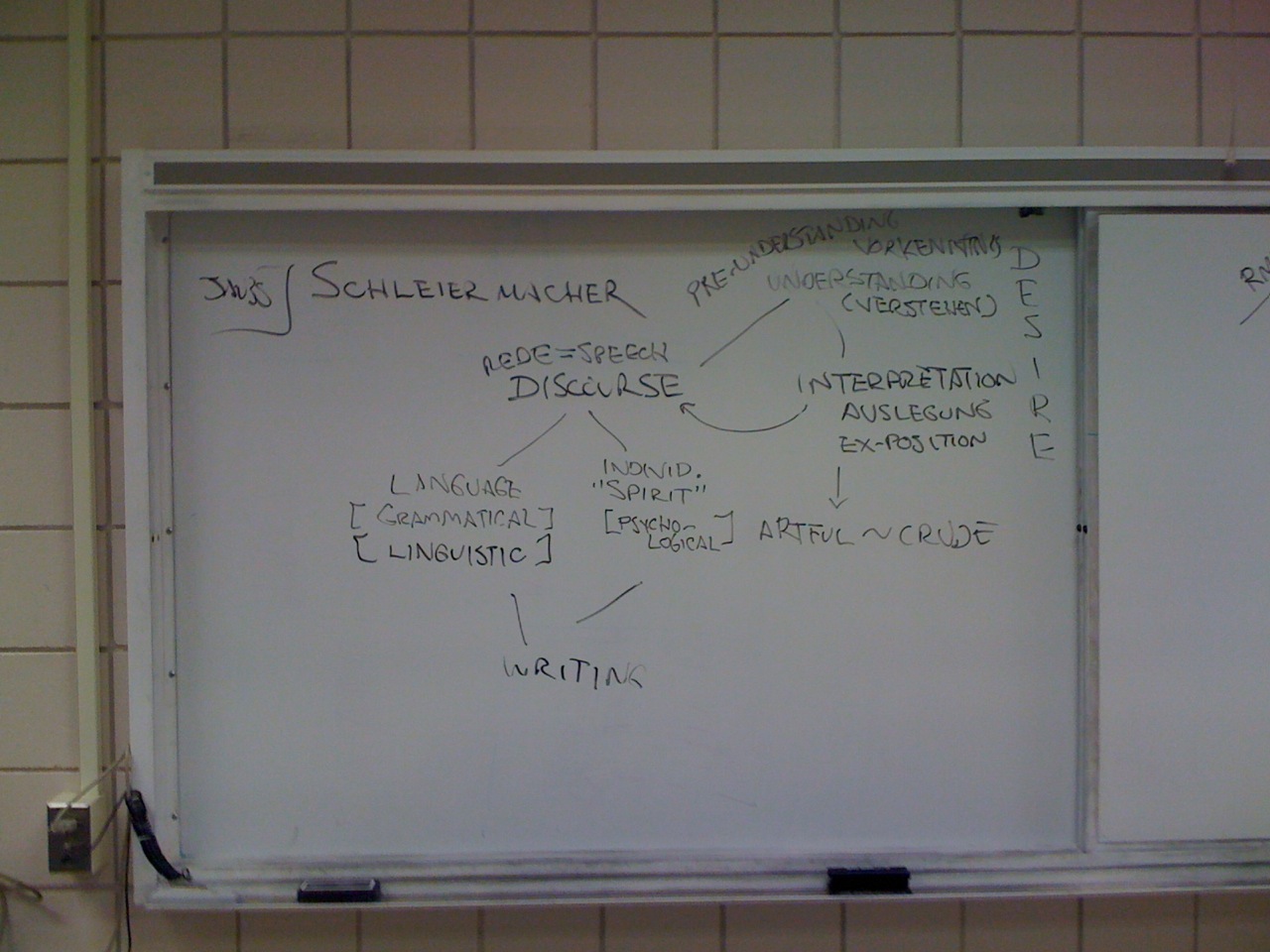
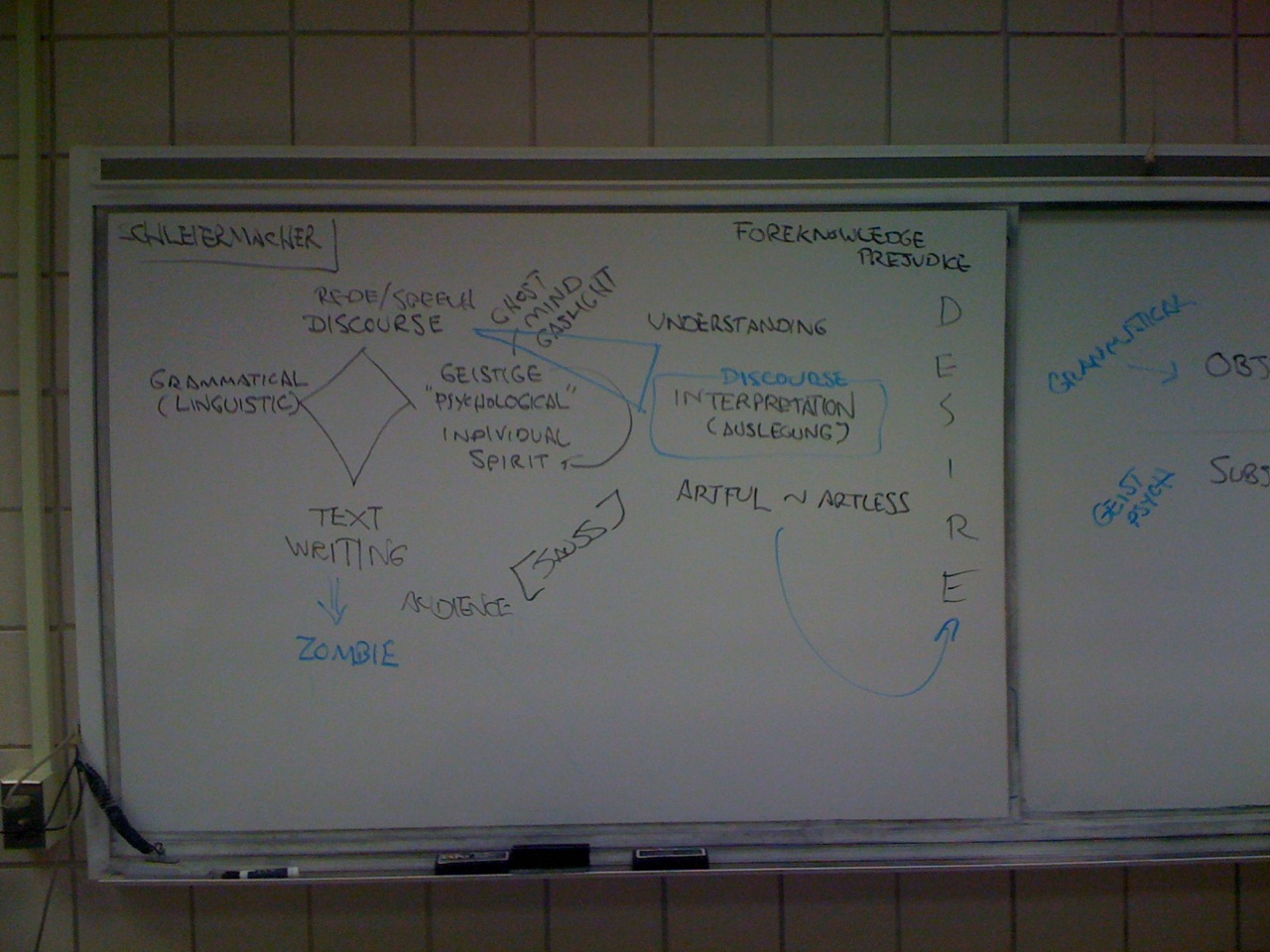
II. Introduction to Scheiermacher's "hermeneutics." Whiteboard (and see handout). Mise-en-abyme: "the act of interpretation" section of a course on "the act of interpretation." Like the old Quaker Oats containers, showing a Quaker holding a container of Quaker Oats in which a Quaker holding a container of Quaker Oats is seen...
week 7 - what is hermeneutics?
13 Oct | Fall Break - no class.
15 Oct | Norton: Poulet (1317-1333); Iser (1670-1682). Freud, Interpretation of Dreams, chap. 2. Aristotle Paper due.
I. In-class writing: "The true story of how my magnificent Aristotle paper was written. Setting, co-stars, plot, etc."
II. Where are we? At the cusp of bidding adieu to Proust & guten tag to Freud. Some "remainders" to carry forward, most importantly Nietzsche.
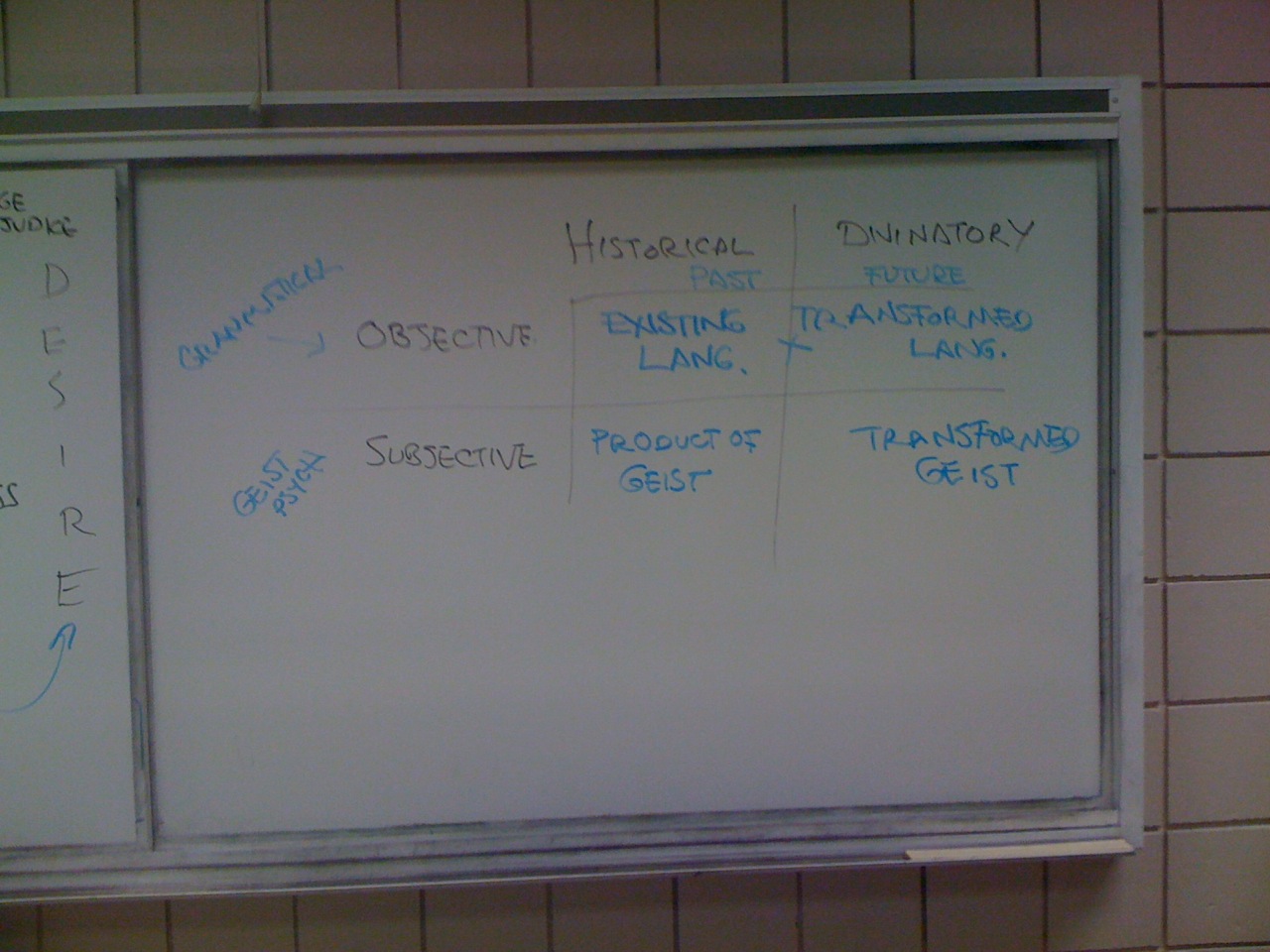
III. Schleiermacher review & discussion. Connections to Poulet. Digression on "pop" music. Whiteboards 1 (the diamond and its pendants) & 2 (objective, subjective, historical, divinatory).
week 8 - what is hermeneutics?
20 Oct | Norton: Jauss (1547-1565). Freud, Interpretation of Dreams, chap. 3.
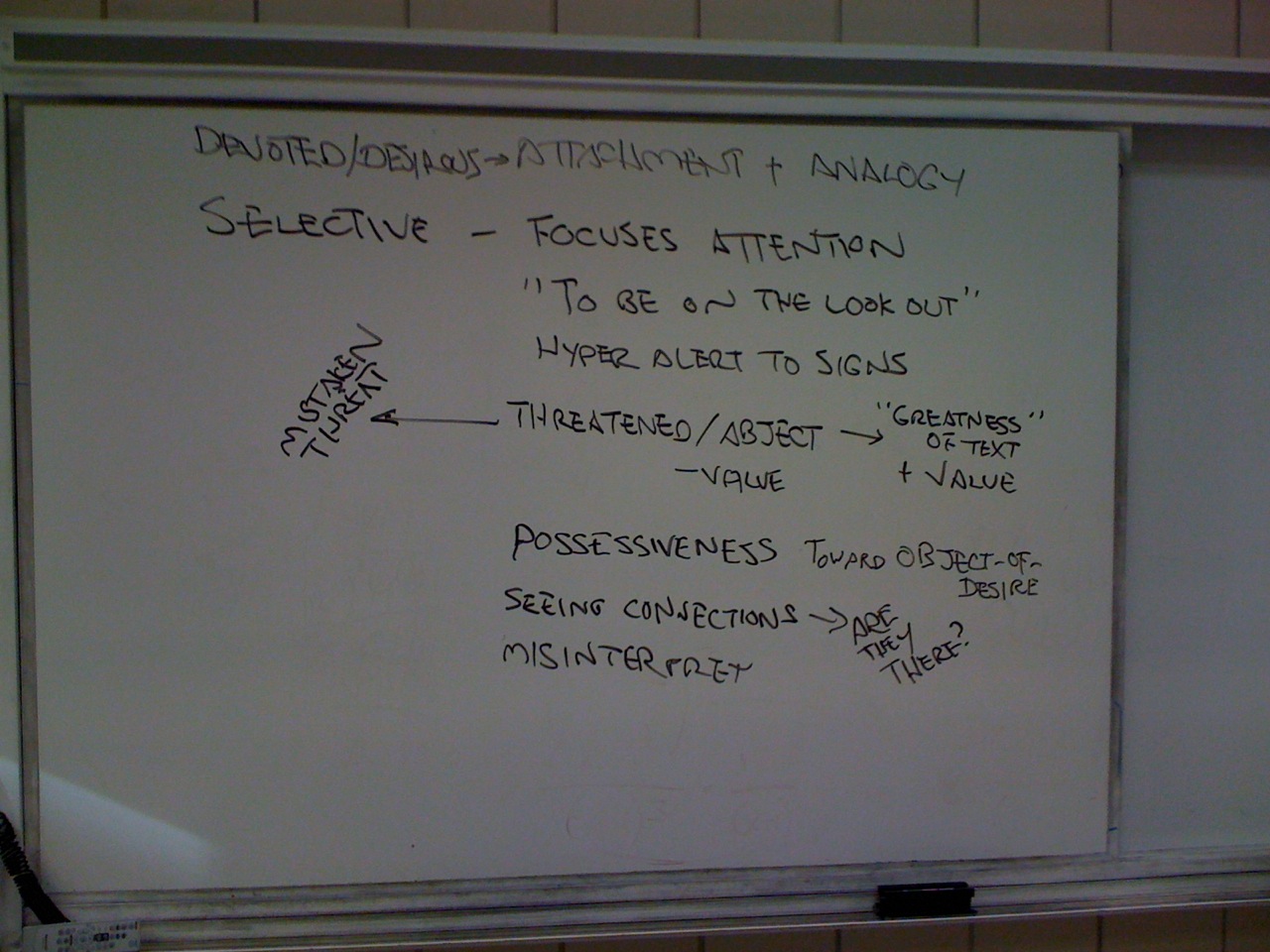
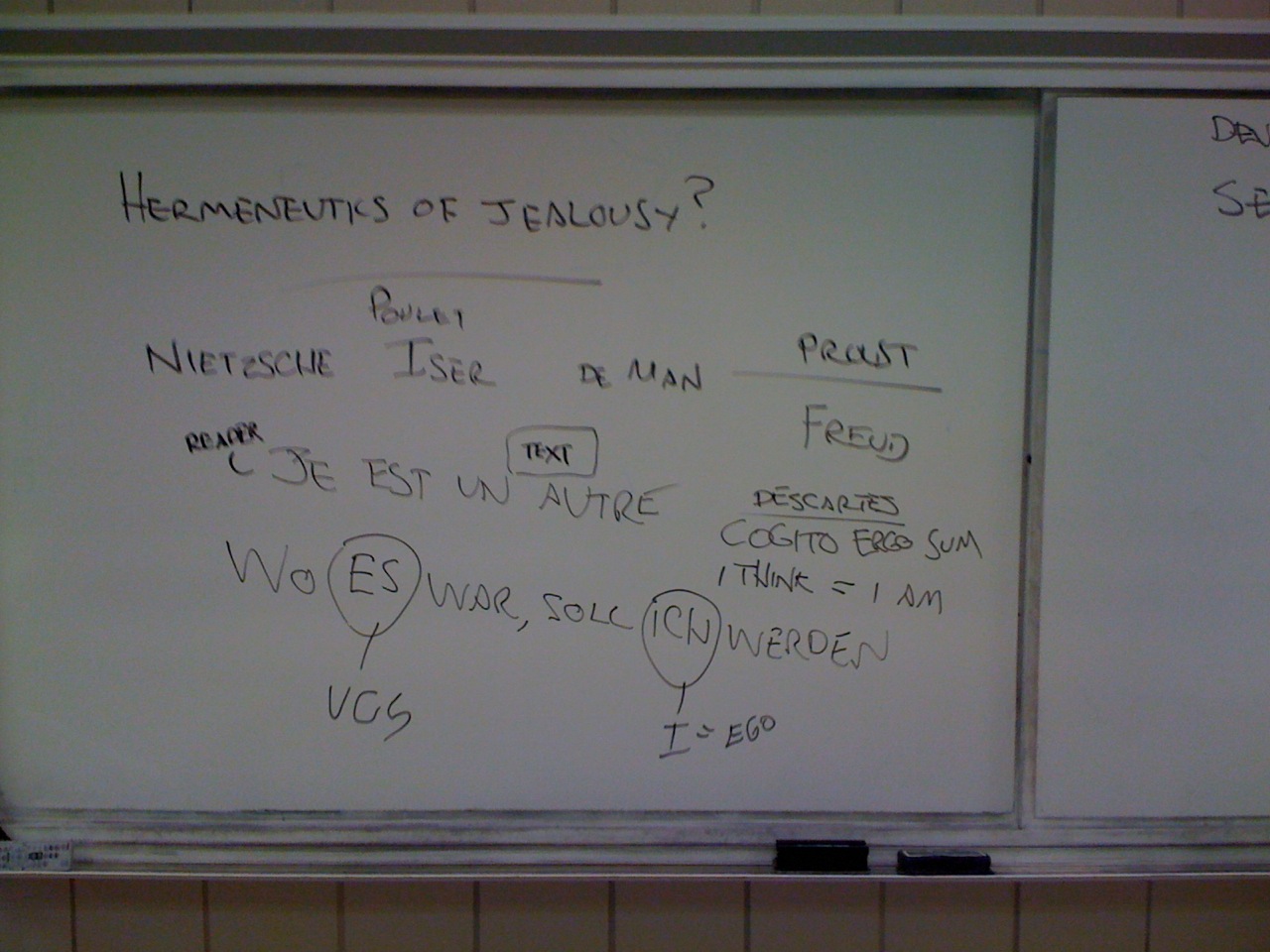
I. In-class writing: the hermeneutics of jealousy. Whiteboard.
II. Poulet on "reading as one ought" (1323).
III. Three phrases indicating very different stances toward human subjectivity:
A. Ego cogito, ergo sum. "I think therefore I am." Rene Descartes. The subject's consciousness is coincident to its being.
B. JE est un autre. "I is an other." Arthur Rimbaud. The subject's identity is coincident to otherness; note grammatical violation of first person pronoun and third person verb conjugation.
C. Wo es war, soll Ich werden. "Where it was, shall I come to be" Sigmund Freud. The subject's consciousness is out of phase with its being; note absence of "present" tense.
D. Whiteboard.
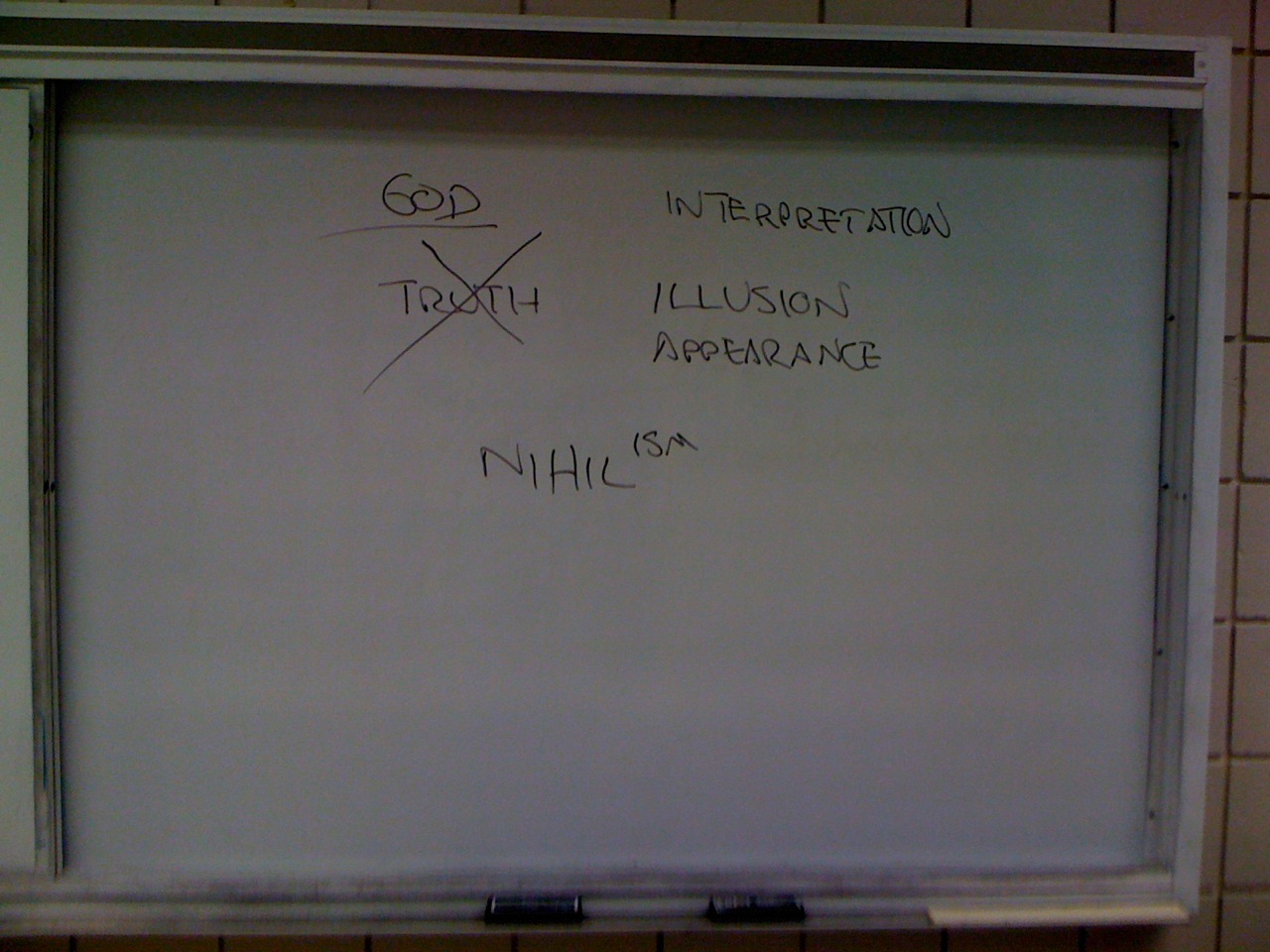
IV. Nietzsche: "What then is truth...." (878). Whiteboard.
22 Oct | Norton: Eichenbaum (1058-1087). Freud, Interpretation of Dreams, chap. 4.
I. Jubilation induced by absence of in-class writing.
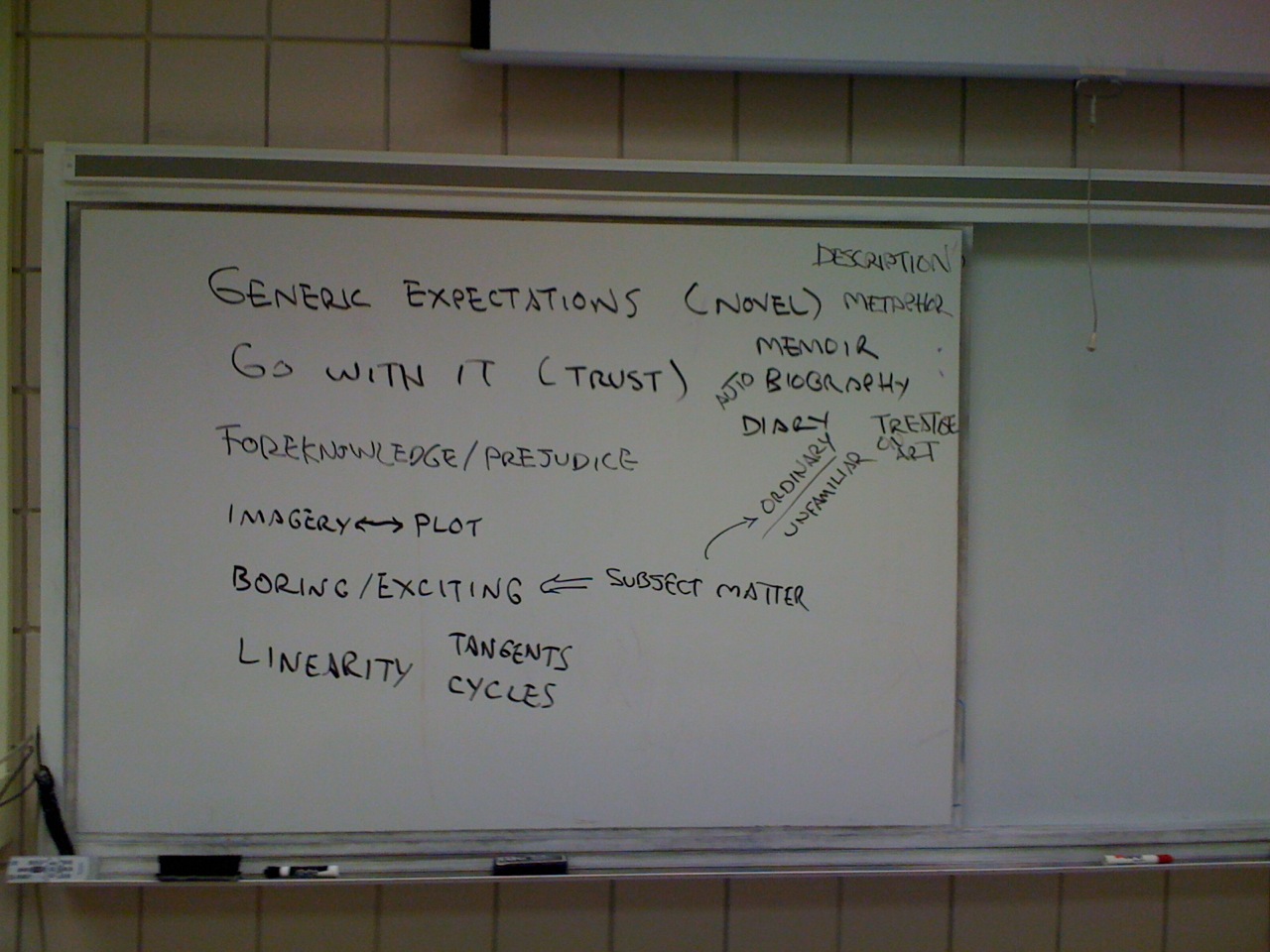
II. Adieu to Proust. Expectations: some overcome, some left intact. Whiteboard.
week 9 - what is intentionality?
27 Oct | Wimsatt & Beardsley, "The Intentional Fallacy" (1371-87); Fish, "Interpreting the Variorum (2067-2089). Freud, through chapter 4.
I. In-class writing: the "secret" of dreams as revealed to Freud? Did he deserve that plaque he fantasized about? A Parisian plaque. And something resembling what he had in mind at Bellevue, outside Vienna.
II. Spring course offerings in English. The future of UMaine. The Chancellor's visit tomorrow. The nascent "English Student Advisory Board."
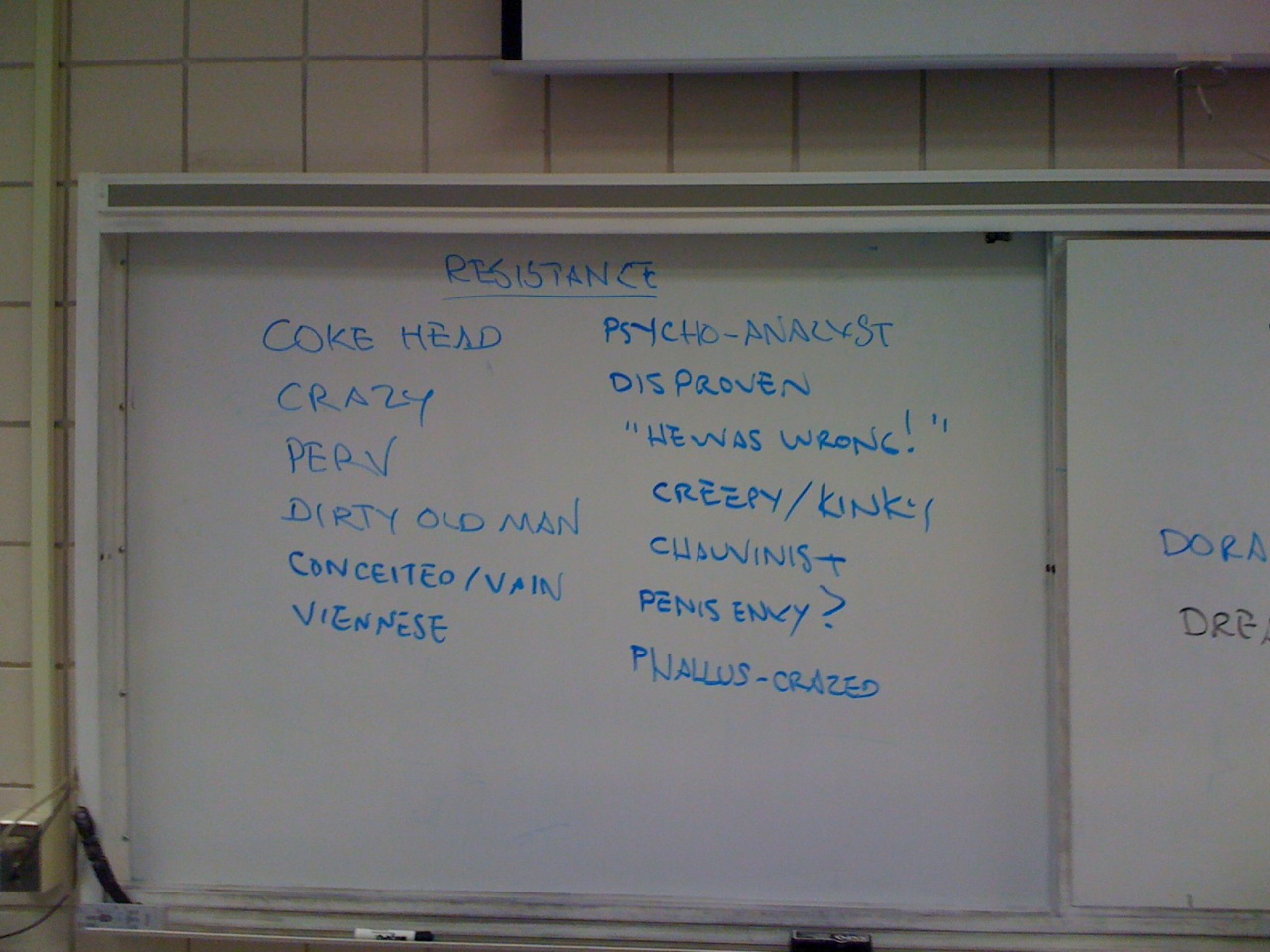
III. Preconceptions about Freud. Whiteboard. The phenomenon of "resistance": "How much of my truth can I communicate to you without you killing me (yet)?" (Socrates, Freud). Taking seriously certain phenomena not previously attended to in a "scientific" fashion: dreams, the discourse of (a certain class of) women, sexuality. The subsequent decision, in the US, to substitute pharmaceutical drugs for the "talking cure."
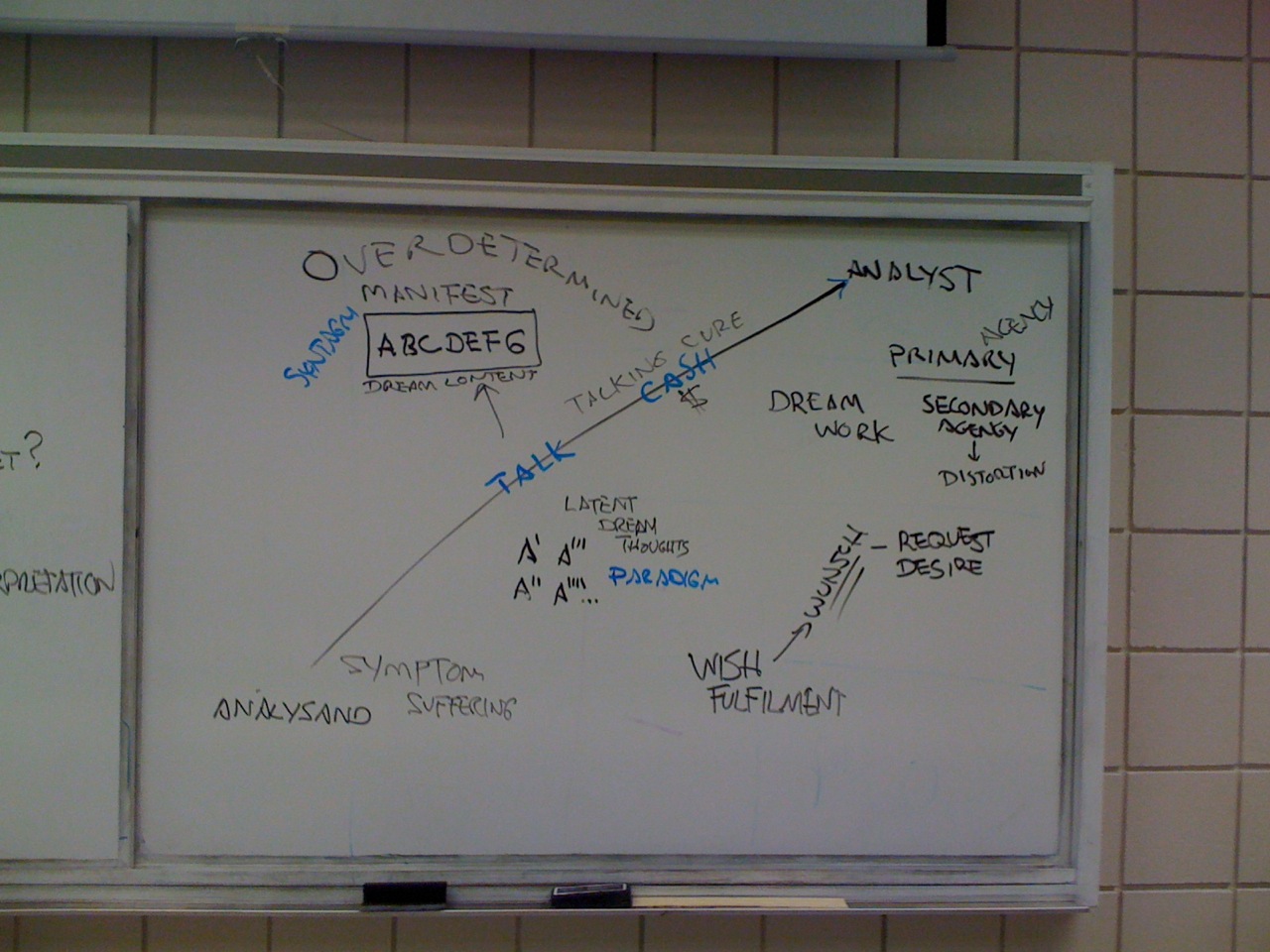
IV. The psychoanalytic situation. Whiteboard. Dialogic, as with Socrates, but involving the exchange of money (from which Socrates demurred, in constrast to the Sophists). A discourse emergent within and embedded within bourgeois capitalism. The couch, contrasted to the confessional. What brings the analysand to the session: a symptom that does not admit of physical (re)solution.
IV. Introduction to the dreamwork. A dream is a fulfilment of a wish (ch. 2) —> A dream is a (disguised) fulfilment of a (supressed or repressed) wish (ch. 4). Distortion and overdetermination. "I'd rather die...than acknowledge this desire."
29 Oct | E.D. Hirsch, "Objective Interpretation" (1682-1709). Freud, through chapter 4.
Forecast: My remarks will focus on Iser (from 15 October) and this week's readings on "intentionality" with an emphasis on Wimsatt & Beardsley.
week 10 - what is an author?
3 Nov | Norton: Gramsci (1135-1144); Sartre (1333-1350); Foucault, "from Truth and Power" (1667-70). Freud, Interpretation of Dreams, chap. 5.
5 Nov | Norton: Barthes (1466-1470), Foucault (1622-1636). Freud, Interpretation of Dreams, chap. 5.
I. In-class writing: What are the main sources of dream materials according to Sigmund Freud (ch. V of IoD)?
II. Preliminary discussion of "The Material and Sources of Dreams."
week 11 - what is an author?
10 Nov | Norton: Eichenbaum (originally scheduled for 22 October); Bakhtin (1186-1220). Freud, Interpretation of Dreams, chap. 6. < I have shifted these two texts to recommended status.
I. In-class writing: What are the main sources of dream materials according to Sigmund Freud (ch. 5 of IoD)? A second try.
II. General remarks on Aristotle papers and review of "rubric."
III. Review of "The Materials and Sources of Dreams." Recent & indifferent materials, infantile or childhood materials, somatic inputs.
IV. Introduction to "The Dreamwork" (ch. 6 of IoD). The work of condensation, the work of displacement.
12 Nov | Norton: Woolf (1017-1030); Gilbert & Gubar (2023-2035). Freud, Interpretation of Dreams, chap. 6.
week 12 - what is ideology?
17 Nov | Norton: Hegel, "The Master Slave Dialectic" (630-36).
19 Nov | Norton: Marx & Engels (759-789). Freud, Interpretation of Dreams, chap. 6.
week 13 -what is ideology?
24 Nov | Norton: Lacan, "The Mirror Stage..." and "The Agency of the Letter in the Unconscious" (1278-1302). Freud, Interpretation of Dreams, chap. 6.
I. Björk's "Heirloom," a Freudian analysis. Plus kitten pictures.
26 Nov | No Class- Thanksgiving Break
week 14 - what is ideology?
1 Dec | Norton: Althusser, "from Ideology and Ideological State Apparatuses" (1483-1509). Freud, "The Uncanny" (929-952).
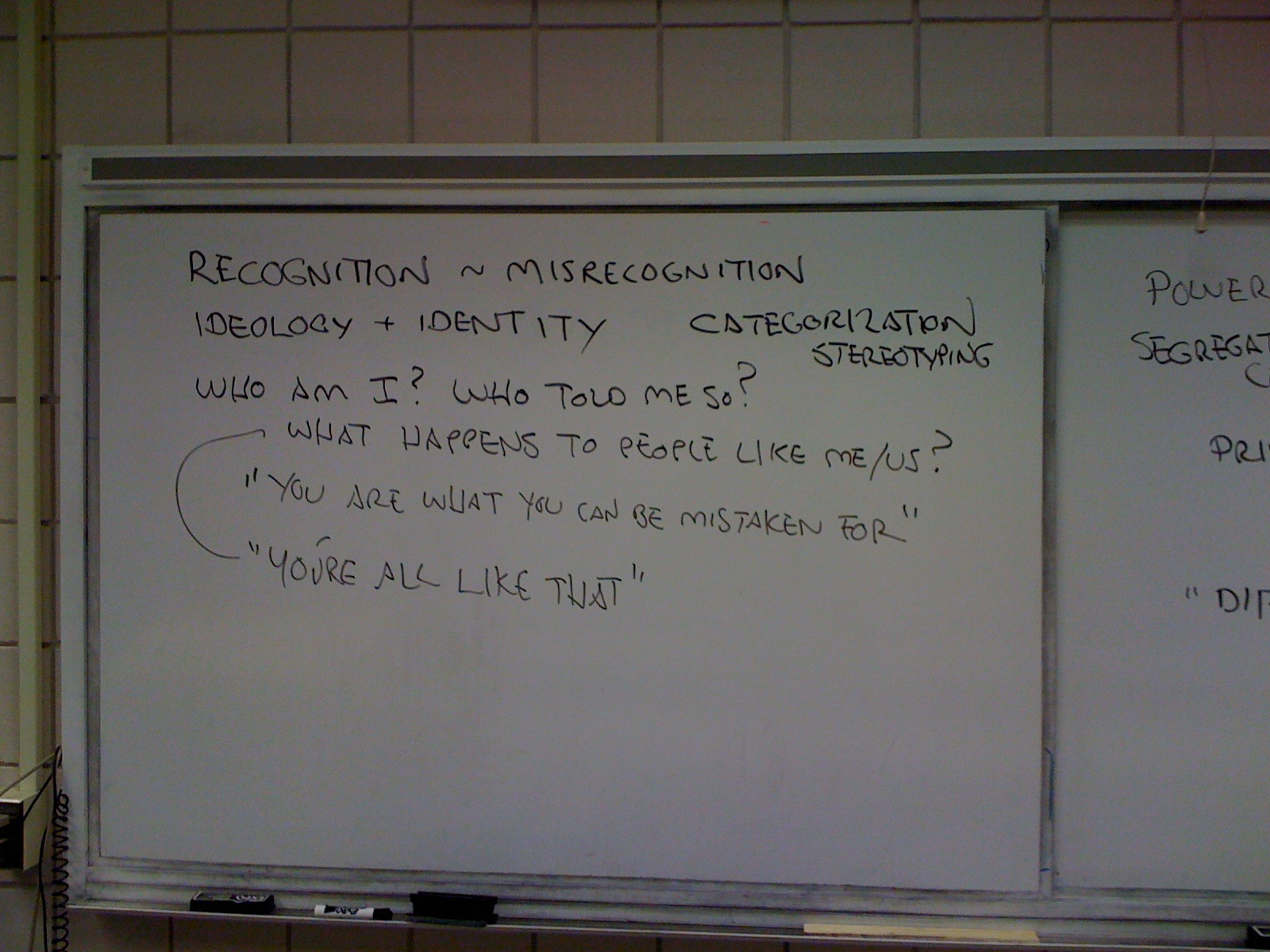
I. Ideology works to confer identity on subjects by answering fundamental questions, such as "Who am I?" "How do I know / who told me so?" "What happens to people like me/us?" "What are the consequences if I forget my place?" The axiom of (mis-)recognition: "You are what you can be mistaken for."
Whiteboard.
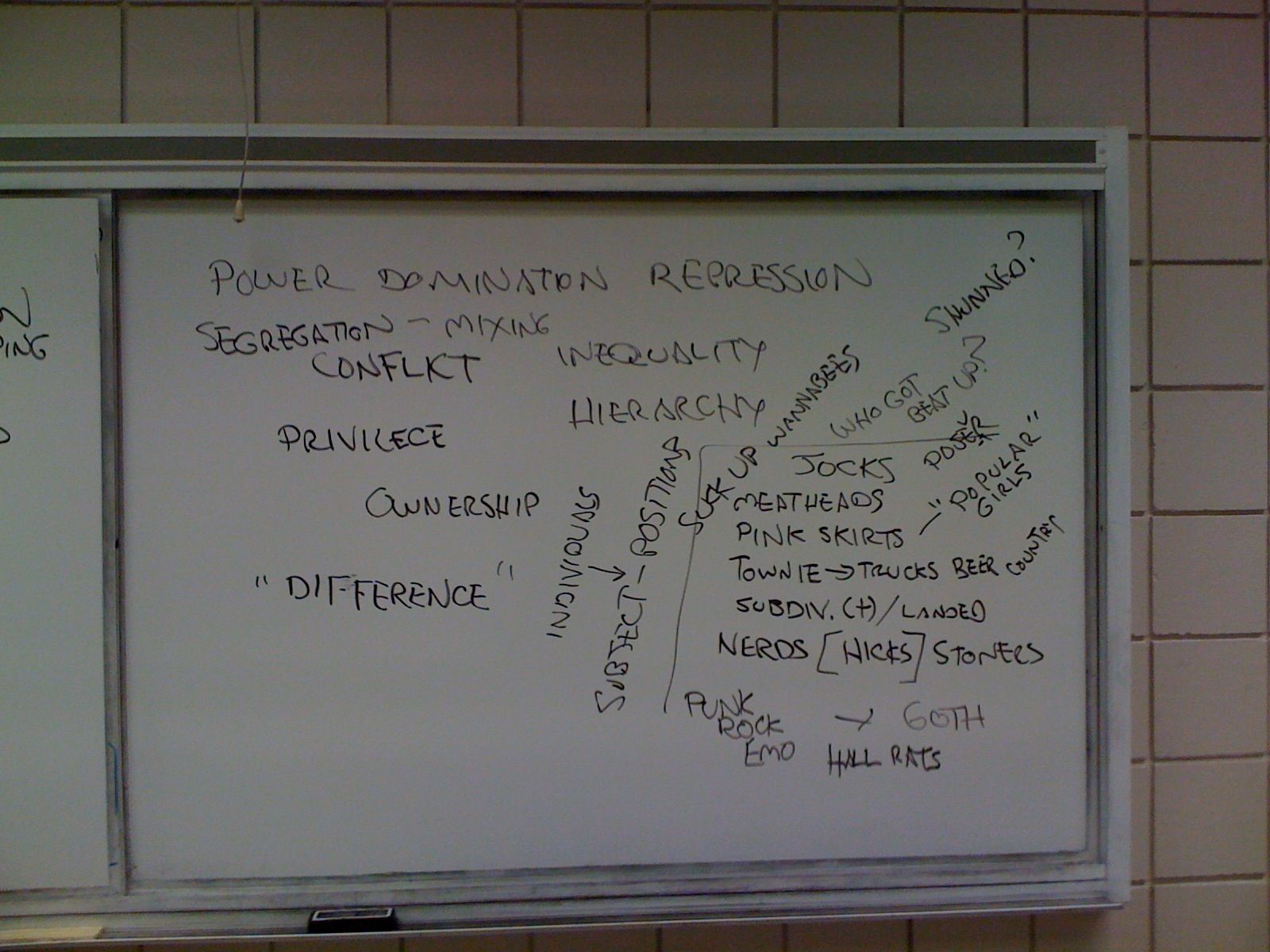
II. Categorical thinking; stereotypes. Individuals recruited to "subject-positions." For example, the subject-positions available in the system of secondary education in Maine. Whiteboard.
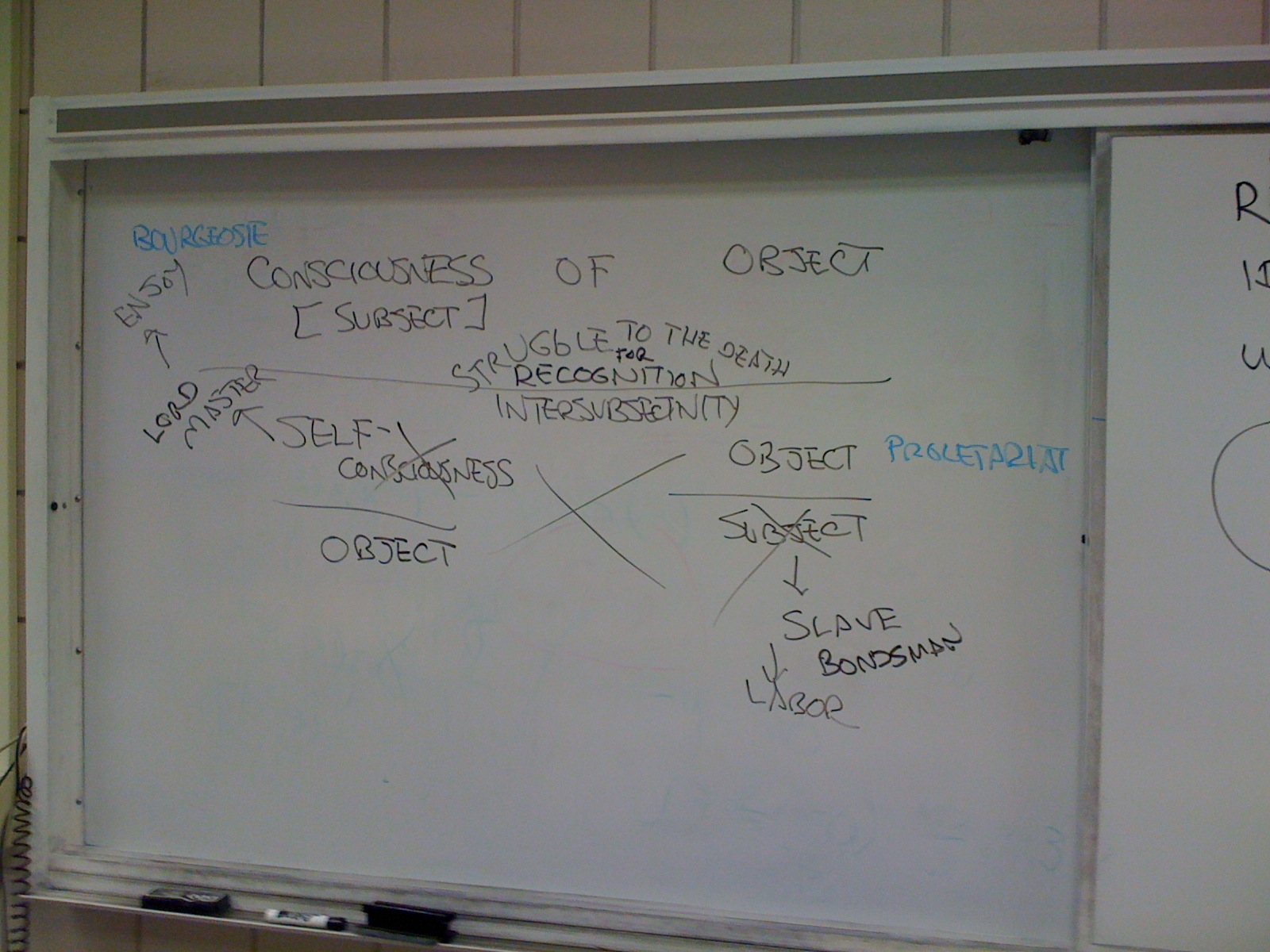
III. Hegel's account of the emergence of "self-consciousness" through "the struggle to the death for recognition" (which might alse be called "the struggle to the death to avoid recognizing the Other"). Whiteboard. Radical hypothesis: freedom as objective meaning of human existence. The Enlightenment and the bourgeois revolutions in France and America. Napoleon's armies outside Hegel's window. Systems of dominance, repression, exploitation, etc.
IV. Hegel's paragraph 194 (634-635) and Marx-Engel's paragraph beginning "The bourgeoisie cannot exist without constantly revolutionizing the instruments of production..." (771).
3 Dec | Norton: Jameson, from "The Political Unconscious" (1932-1975). Freud, "The Uncanny" (929-952).
week 15 - what is ideology?
8 Dec | Norton: Jameson (1932-1975).
10 Dec | Conclusions
finals week
Cumulative Final Exam.
|